
Foundation Repair in Irving, TX
Our shop sits at 220 W 6th St, a few blocks from the old Rock Island depot and the Heritage District square. That matters for one reason: when you call, the truck is usually already somewhere between Loop 12 and MacArthur Blvd, and we can be under your house the same week instead of the same month.
Irving is really two housing markets stacked on top of each other. South of SH 183, the streets around Nursery Rd, Sowers Rd, and the Heritage District were platted in the 1940s through the 1960s, and a large share of those homes still sit on cedar or concrete piers with a wood floor system. North of the freeway, Las Colinas, Valley Ranch, and the subdivisions along Belt Line and MacArthur went up in the 1980s and later on slab-on-grade concrete. Both types move, but for different reasons and with different fixes.
Under all of it is Houston Black clay, the Blackland Prairie soil that gives Irving its dark yards and its foundation problems. It takes on water and swells in a wet spring, then shrinks and pulls away from the slab in an August drought. The Elm Fork of the Trinity River hems in the east side of town, so the lots closest to it stay saturated longest and dry out slowest.
Why Irving homes shift more than the builder expected
The clay under Irving can change volume by several inches between a wet March and a dry September. A slab poured directly on it rides those changes. The edges dry first, so the perimeter drops while the center stays put, which is why you see cracks fanning out from the corners of windows and doors that stick in late summer and swing free again in winter.
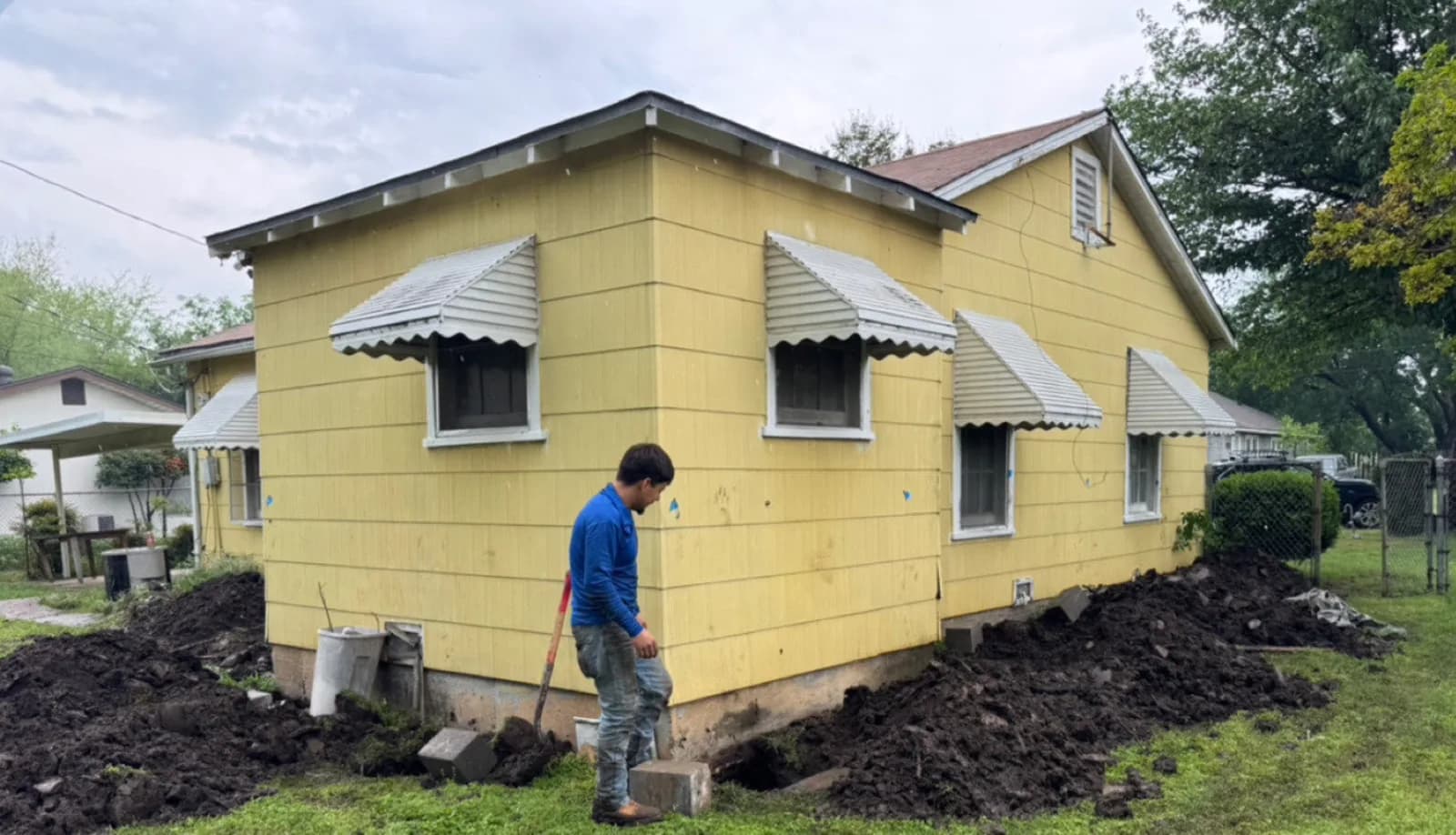
Pier and beam homes in the older parts of town have a different failure. The original piers were often set shallow, in some cases on nothing more than a concrete pad a foot below grade. Sixty years of wet and dry cycles rock them loose, and the wood beams they carry sag between supports. Add a crawl space that never dries out because the yard drains toward the house, and the beams rot on top of sinking.
The repairs we do most in Irving
In the Heritage District, Plymouth Park, and the neighborhoods off Rochelle and Shady Grove, most of our calls end in pier and beam work: replacing crushed or leaning piers, sistering rotted beams, and re-shimming the floor system so the doors line up again. Where the crawl space is chronically wet we pair that with drainage and crawl space repair so we are not back in five years.
Up in Las Colinas, Valley Ranch, and Hackberry Creek, the job is usually slab foundation repair: pressed concrete piers driven to refusal along the settled edge, then a controlled lift to bring the slab back to within tolerance. When the movement is on the uphill side of a lot that sheds water toward the house, we will recommend a French drain before the piers, because the piers only fix the symptom.
What an inspection in Irving looks like
We start outside with a walk around the perimeter looking at brick lines, weep holes, expansion joints, and where the gutters dump. Then we take elevation readings across the interior floor with a level so we know how many inches the low side has dropped and in what direction. On a pier and beam house we go under it with a light and a probe to check every pier and the condition of the beams and joists.
You get a written estimate before we leave, itemized by pier and by drain footage. Because Irving is home, we do not add a travel line to the price. If the house does not need repair yet, we tell you that and show you what to watch.
Irving homeowners ask
Free foundation estimate in Irving
We are a few minutes from every Irving neighborhood. Call for a free inspection and a written price the same visit.